Troubleshooting · Nocatee 32081
Sub-Zero Not Cooling in Nocatee? Start Here
Warm milk in a premium built-in feels like an emergency. Usually it's a fixable airflow or control problem — here's how to tell.
A Sub-Zero that's warm in Nocatee usually has an airflow problem, not a dead compressor: dust-clogged condensers and stalled evaporator fans cause most of the not-cooling calls we run in 32081. Work through the five checks below; if cooling doesn't return within 24 hours, book a diagnosis — most fixes land between $250 and $1,100.
For independent Sub-Zero repair across Nocatee and the 32081 master plan, call (904) 902-0927 for a same-week written quote or Book online.
Checked against current field notes · June 13, 2026
Run these five checks before you call anyone
Twenty minutes here saves some owners a service visit entirely — and gives the rest of you exactly the details dispatch needs to send the right parts.
- Confirm the controls are awake. If the display is dark or unresponsive — especially after a storm outage — flip the unit’s breaker off for thirty seconds and back on. BI-series boards can lock up when power returns dirty, and a clean restart clears more of these than owners expect.
- Look at the condenser area. Pop the grille at the top (or the kickplate below on some models) and look at the coil. A felt-like mat of dust means the unit is fighting for airflow; vacuum what you can reach gently with a brush attachment.
- Listen for the fans. A healthy Sub-Zero has audible fan movement. If the compressor hums but you hear no air moving inside the cabinet, a stalled evaporator fan is a prime suspect — and a moderate, not catastrophic, repair.
- Test the door seal. Close a dollar bill in the door and pull. If it slides out with no drag anywhere along the gasket, humid Florida air is pouring in, icing the evaporator and stealing capacity.
- Verify the set points and wait. Sub-Zero designs around 38°F in the refrigerator and 0°F in the freezer. After any power event or settings change, give the unit a full 24 hours to stabilize before judging it.
Still warm after a stable 24 hours? That's the point where a meter and a frost-pattern read beat guesswork, and where a refrigerator repair visit earns its fee.
Match the symptom to the likely cause and cost
These are the patterns from our own 32081 call sheet, with the planning lane each one usually lands in. Final numbers always come as a written quote before any part goes in.
| What you're seeing | First thing we check | Planning lane |
|---|---|---|
| Refrigerator warm, freezer fine | Evaporator fan and refrigerator-side airflow | $250–$550 |
| Both sides warm, compressor never stops | Condenser condition, then refrigerant evidence | $250 cleaning to $1,500–$3,000 sealed system |
| Panel dark after a storm outage | Breaker reset, then control board health | $550–$1,100 if the board took the surge |
| Warm with repeated clicking | Start components and compressor electricals | $550–$1,100; $1,000–$2,000+ if the compressor is gone |
| Temps swinging, doors sweating | Gasket condition and door alignment | $550–$1,100 |
Why Nocatee units lose cooling in storm season
Nocatee sees storms on more than a hundred days a year, and the surge that rides in when power is restored — often 50 to 100 percent over nominal — is exactly what kills Sub-Zero control boards. The BI generation installed across Coastal Oaks and the Del Webb-era streets is especially prone to coming back from an outage with lights on and a blank, locked panel; our notes on how BI-series boards behave after outages cover it in detail.
The slower killer is dust. With Seabrook Village and The Outlook still building out, construction grit travels, and a condenser that should get attention every six to twelve months can mat over in far less. A scheduled coil-cleaning visit is the single cheapest way to keep a built-in out of the not-cooling column — and our yearly inspection catches the gasket and drain problems that humidity feeds.
An educational diagnostic scenario from Anthem Ridge
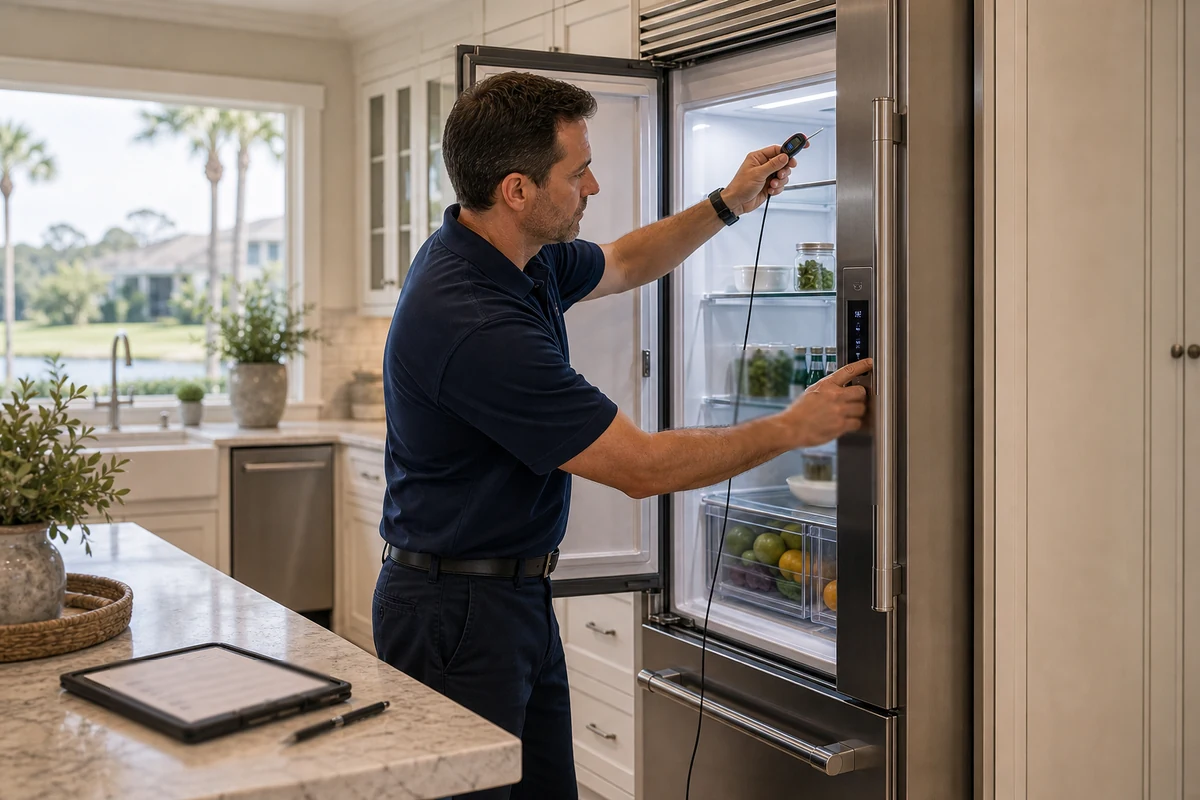
Educational diagnostic scenario — a composite teaching example, not a customer review. A 2014 BI-36U in an Anthem Ridge kitchen reads 52°F up top while the freezer holds 0°F. The owner reports a brief outage two nights earlier. The panel is responsive, so the board survived; with the compressor running and no air movement behind the upper vents, the refrigerator-side evaporator fan tests open. One motor, one visit, moderate lane — and the food moved to the freezer side made it through. The lesson: a working freezer means the sealed system is usually intact, so don't assume the worst.
What a not-cooling visit costs in 32081
Sub-Zero Service Nocatee services warm and not-cooling Sub-Zero units across Nocatee 32081 — call (904) 902-0927 or use the online reservation page, and a tech arrives with the common airflow and control parts already on the truck. The visit produces a written finding and a firm quote before repair work starts.
Minor work — a cleaning, a fan motor — runs $250 to $550. Boards, thermistors, and gaskets sit in the $550 to $1,100 lane. Compressors run $1,000 to $2,000 and up, and full sealed-system work reaches $1,500 to $3,000; we don't quote either without airflow, electrical, and frost-pattern evidence first. If your display is also throwing a code, read what an EC 50 readout means before you panic, and if your unit is new enough to be covered, our guide to factory warranty versus independent repair will route you to the right door first.
What a technician does on arrival
If the five checks didn't restore cooling, here's exactly what happens when the tech walks in — diagnosis runs cheapest-cause-first by design, so nobody pays for sealed-system testing while a coil is wearing a sweater of dust.
- Read the history and the panel. When the symptom started, whether a storm outage preceded it, and whether the display responds. A blank panel after an outage points at a board before anything else gets touched.
- Measure both compartments. Actual temperatures, not "feels warm" — the fresh-food and freezer readings together say whether the sealed system is intact, because a working freezer almost always means it is.
- Check airflow and the fans. Condenser dust load, condenser fan draw, and the evaporator fan you should hear moving air. A stalled evaporator fan is the most common warm-fridge cause we find in 32081.
- Test the seal and the board. A dollar-bill drag test on the gasket and a board power-up where the symptoms warrant it, before any sealed-system talk.
- Gather pressure evidence only if needed. If — and only if — airflow and electrical have cleared and a partial evaporator frost pattern points at a leak, we read refrigerant pressures. That's the gate every sealed-system quote has to pass.
Related symptoms that ride along with a warm Sub-Zero
| The companion symptom | What it tells us | Where to read more |
|---|---|---|
| EC 50 code on the display | The compressor has been running far too long — usually airflow | EC 50 explainer |
| Small or hollow ice | Scale-restricted fill, not a cooling fault at all | Ice maker repair |
| Frost on the freezer back wall | Defrost system, which chokes airflow and warms the fridge | Frost & defrost guide |
| Doors sweating, gasket loose | Humid air leaking in, stealing cooling capacity | Condensation guide |
Not-cooling questions, answered straight
Why is my Sub-Zero refrigerator warm while the freezer side still works?
Most built-in Sub-Zeros cool each compartment with its own airflow path, and many run two separate sealed systems. A warm refrigerator over a working freezer usually points to the refrigerator-side evaporator fan, an iced coil, or a control fault — not a dead machine. It is one of the more affordable not-cooling patterns we diagnose.
How long should a Sub-Zero take to recover after a Nocatee power outage?
Expect roughly 24 hours to return fully to 38°F and 0°F, assuming the doors stayed closed. If the panel is lit and fans are running but temperatures have not moved after a day, stop waiting — restoration surges after storms are a documented killer of control boards, and continuing to run a faulted unit risks the food and the compressor.
Should I unplug a Sub-Zero that has stopped cooling?
If it is warm but running quietly, leave it on and book a visit — the diagnostic data on the board is useful. Unplug it only if you hear repeated hard clicking, smell anything electrical, or see water reaching the floor. Built-ins are hardwired through a breaker in many homes, so the panel switch is the safer off button.
Can a dirty condenser really make a refrigerator stop cooling entirely?
Yes, and we prove it weekly. The condenser sheds the heat the system collects; bury it in dust and the refrigerant never re-condenses properly, so the compressor runs constantly while temperatures climb. Sub-Zero calls for cleaning every six to twelve months, and in a community still under construction we recommend the short end of that range.
How warm is too warm before I should stop waiting and book a Nocatee visit?
If the fresh-food side climbs past 45°F and holds there for more than a couple of hours, stop waiting and call — that is the line where food safety and compressor strain both start to matter. Below that, after a settings change or brief outage, give it the full 24 hours to stabilize. We triage warm-fridge calls ahead of routine maintenance, so a unit climbing past 45°F gets bumped up the schedule.
My Sub-Zero cools fine overnight but warms by afternoon — what causes that pattern?
A unit that holds at night and drifts in the afternoon is usually telling you about heat load it can almost, but not quite, keep up with: a marginal condenser exposed by warmer daytime kitchen temperatures, a door opened often around meals, or a gasket that leaks more as the house warms. It rarely points to the sealed system, which fails steadily rather than on a daily cycle. Start with a coil check and the door-seal test.
Ready when your Sub-Zero isn't
Weekdays 8 to 7, Saturdays 9 to 3. Gate access handled, floors protected.