Maintenance · The $250 habit that prevents $2,000 repairs
Sub-Zero Condenser Coil Cleaning in Nocatee
One unglamorous hour with a vacuum and a fin comb does more for a Sub-Zero's lifespan than any other service we sell.
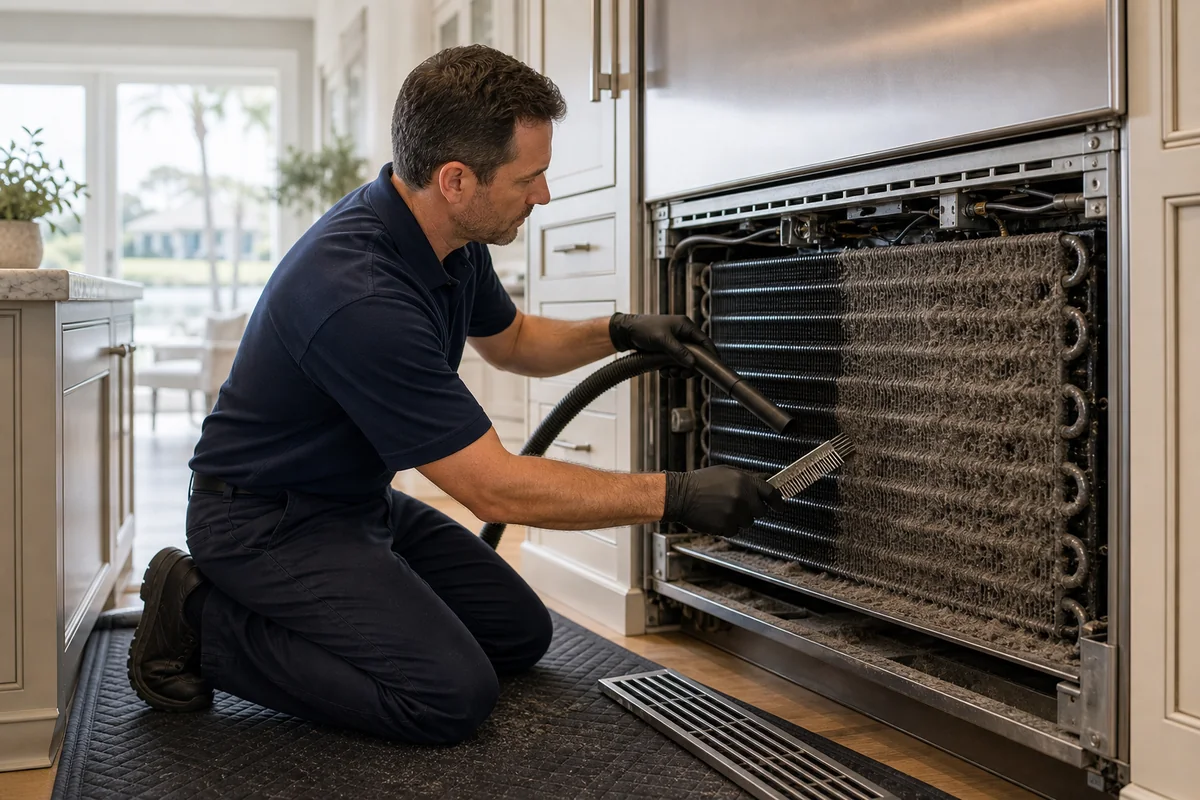
Sub-Zero Service Nocatee runs condenser coil cleaning visits across 32081 from $250, usually inside an hour. Sub-Zero recommends cleaning every six to twelve months; with construction dust still blowing around Seabrook Village and The Outlook, we book most Nocatee homes at six. A clean coil is the cure behind most EC 50 codes we clear.
For independent Sub-Zero repair across Nocatee and the 32081 master plan, call (904) 902-0927 for a same-week written quote or Book online.
Intervals and pricing reviewed June 13, 2026.
What a dirty coil actually does to a Sub-Zero
The condenser is where your Sub-Zero® dumps the heat it pulled out of your food. Dust on the fins works like a blanket: heat rejection drops, the compressor runs longer and hotter to hold 38°F and 0°F, and the control logs excessive run time — which is precisely what an EC 50 code means. Most EC 50 calls in our log close with a vacuum, a fin comb, and a cleared display rather than a part.
Left alone, the blanket gets expensive. Sustained hot running is the classic slow killer of compressors, and a compressor is a $1,000–$2,000 line item. That arithmetic — and not a service quota — is why this page exists. When cleaning stops fixing the symptom, the problem has moved, and the refrigerator diagnosis visit takes over.
Booking is simple: call (904) 902-0927 or pick a slot on the reservation page, and we'll handle Coastal Oaks gate clearance ahead of time if that's your street.
Your interval depends on your street
Six to twelve months is the manufacturer's spread. Where you land inside it depends on what your kitchen breathes.
| Your situation | Sensible interval | Why |
|---|---|---|
| Near active building — Seabrook Village, The Outlook | Every 6 months | Framing and lot dust travels and mats fins fast |
| Pets in the house | Every 6 months | Hair felts the coil quicker than dust alone |
| Established street, no pets | Every 9–12 months | Normal household load; annual usually holds |
| Garage or summer-kitchen unit | Every 6 months | Heat, pollen, and humidity all work against it |
How the visit goes, start to finish
- Open the bay. Power down, pull the grille or kickplate, and photograph the dust load — you get the before picture, every time.
- Vacuum and comb. Fins front and rear, then a fin comb for the matted layer a vacuum can't lift, then the fan blades and housing.
- Check the fan, clear the codes. Free spin, normal current draw, and any EC 50 history wiped from the display.
- Verify and close. Panels back on, unit pulling toward 38°F and 0°F before we leave the kitchen.
Most single units take under an hour. Households running a column pair plus wine storage — common in Twenty Mile customs — book a longer window, and the annual checkup bundles all of it with gasket, drain, and water-path checks in one stop. If your cartridge is due anyway, the filter swap rides along for the cost of the part.
When a cleaning is the whole fix — and when it isn't
Cleaning cures the most common long-run and EC 50 complaints, but not all of them. Here is how the symptom tells us whether the coil is the answer or only the first step.
| What you're seeing | Cleaning likely fixes it | Cleaning rules it out, then we look deeper |
|---|---|---|
| EC 50 with a visibly dusty grille | Yes — most close with a vacuum and a cleared code | If EC 50 returns within days on a clean coil |
| Both sides slightly warm, long run times | Often — restored airflow drops the run time | If temps don't recover after 24 hours |
| Compressor hot to the touch, runs nonstop | Sometimes — heat rejection improves immediately | If the compressor stays hot on a clean coil |
| Partial frost on the evaporator, slow warm-up | No — this is a sealed-system signature | Always — we gather pressure evidence next |
When the coil is spotless and the symptom survives, the problem has moved downstream to a fan, a board, or the sealed system — at which point the refrigerator diagnosis takes over and the cleaning becomes the first ruled-out cause rather than the bill.
A seasonal rhythm for Nocatee coils
The two hardest things this climate does to a condenser — summer heat and storm-season load — both peak in the same months, so timing the cleaning matters as much as doing it.
| Time of year | What's working against the coil | What to do |
|---|---|---|
| Spring (Mar–May) | Pine and oak pollen, pre-summer dust | Book the deep cleaning before June heat arrives |
| Summer (Jun–Sep) | Peak ambient heat plus storm-season run cycles | Quick owner vacuum of the grille mid-season |
| Fall (Oct–Nov) | Settling construction dust near new villages | Second cleaning if you live by active building |
| Winter (Dec–Feb) | Lightest load of the year | Good window for the full annual checkup |
Bundle the spring cleaning with the rest of the annual once-over and most Nocatee units sail through storm season on a clean coil and verified temperatures.
What moves a coil-cleaning visit up or down the range
Most single units sit at the $250 floor, but a few things push toward the top of the $250–$550 lane. None of it is a surprise — we quote the number before the kickplate comes off.
| Factor | Toward the $250 floor | Toward the $550 end |
|---|---|---|
| Unit count | One built-in, single kitchen | Column pair plus wine or undercounter |
| Access | Grille clears, unit pulls forward easily | Tight surround or a unit needing a full pull |
| Dust stage | Maintained on schedule, light load | Years of matted film and pet hair, fins to comb |
| Add-on checks | Coil and fan only | Gasket, drain, and filter folded in |
The cheapest version of this service is the maintained one — a unit cleaned on its interval never reaches the matted, full-pull condition that pushes the bill up. That is the entire argument for the standing schedule over the emergency call, and the annual once-over is how multi-unit Twenty Mile households keep the whole lineup in the lower lane.
Coil questions from around the master plan
Can I vacuum the Sub-Zero condenser myself between visits?
Please do — pop the grille and run a soft brush attachment over what you can reach. The honest difference on our visit is the part you can't reach: matted dust deep in the fins, the fan blades and housing, and the current draw and temperature checks that confirm the cleaning actually changed something.
Where is the condenser on a built-in Sub-Zero, anyway?
Up top, behind the grille panel above the doors on most built-ins — not at the floor like a freestanding fridge. That placement pulls kitchen air, with its cooking film and dust, straight through the fins. Undercounter and some integrated units flip it to a kickplate-level coil instead; we service both layouts.
Does construction around Seabrook Village really clog coils faster?
Measurably. Homes within a few streets of active building show heavier fin loading at twelve months than established streets show at eighteen — graded lots and framing dust travel. While Seabrook Village and The Outlook keep building out, nearby kitchens do better on a six-month cleaning cycle. Once the dust settles, the interval can relax.
What actually happens if the coil never gets cleaned?
The unit compensates until it can't. Heat rejection drops, compressor run time stretches, the display eventually throws an EC 50, and food temperature follows. The real bill is longevity: a compressor that runs hot for years dies young, and that's a $1,000–$2,000 repair purchased to avoid a $250 cleaning.
Will a coil cleaning lower my power bill on a Sub-Zero?
Modestly, yes. A coil buried under dust forces the compressor to run longer to hold 38°F and 0°F, and longer run time is more kilowatt-hours. The savings won't pay for the visit on its own — the real return is the compressor you don't replace and the food you don't lose. Treat the efficiency bump as a small bonus, not the reason.
Is the upper-grille condenser on a built-in safe for me to vacuum?
Yes, the grille area is owner-friendly — power down, lift the grille, and run a soft brush attachment over the fins you can reach. Stay out of the fan housing and don't bend the fins; a fin comb fixes flattened ones but a vacuum nozzle can flatten them. What we add is the deep, matted layer behind the front fins and the current-draw check that proves the cleaning worked.
How long after a coil cleaning should I expect the temperature to come back down?
Give it a full 24 hours. Clearing the fins restores heat rejection immediately, but the compartment has to shed the heat it accumulated while the coil was choked, and Sub-Zero builds in a stabilization window. If a unit was throwing EC 50 from a dirty coil, the code clears on the visit and temperatures settle to 38°F and 0°F within that day. If they don't, the coil wasn't the whole story and we move to the next check.
Does a coil cleaning help a Sub-Zero in a hot Nocatee garage more than one in the kitchen?
Considerably more. A garage or summer-kitchen unit fights ambient heat plus pollen and grit, so its coil loads faster and the penalty for a dirty one is steeper — the compressor is already running long against the heat before dust adds a blanket. Those units earn a six-month interval and repay it in compressor life. Conditioned kitchens on established streets can usually stretch to nine or twelve months.
Ready when your Sub-Zero isn't
Weekdays 8 to 7, Saturdays 9 to 3. Gate access handled, floors protected.