Repair · Hard-water specialists · 32081
Sub-Zero Ice Maker Repair Built for Nocatee Water
Most ice maker failures here aren't really ice maker failures — they're plumbing-side mineral problems wearing an ice maker costume.
Sub-Zero Service Nocatee repairs ice makers across the 32081 master plan, where tap water measures 14–28 grains per gallon — among Florida's hardest. Scale-restricted fill valves cause most failures we see; descaling runs $250–$550, valve or module replacement $550–$1,100, with the number in writing before work starts.
For independent Sub-Zero repair across Nocatee and the 32081 master plan, call (904) 902-0927 for a same-week written quote or Book online.
Current as of June 13, 2026 — pricing lanes checked against this season's jobs.
Why 32081 water beats up ice makers first
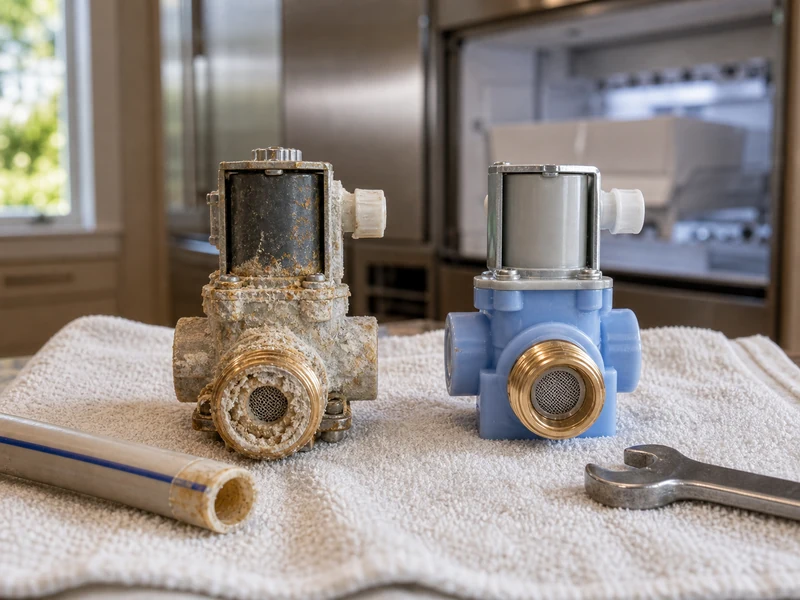
Nocatee's supply comes out of the limestone Floridan aquifer, and the dissolved mineral load — 14 to 28 grains per gallon, stiffening toward the St. Johns Forest side of the county — has to go somewhere. In a Sub-Zero®, it goes to the narrowest, warmest points in the water path: the inlet valve, the filter head, and the fill tube.
The ice maker is simply where you notice it. Cubes shrink, slow down, go cloudy, then stop. The kettle in your Twenty Mile kitchen shows the same crust — the difference is the kettle doesn't have a solenoid fighting through it. That's also why the Coastal Oaks ice maker pattern is so consistent: the oldest water paths in Nocatee have had the longest mineral exposure.
We service Sub-Zero ice makers everywhere in Nocatee 32081. Call (904) 902-0927 or grab a slot through the booking page — mention what the ice looks like and we'll arrive with the likely parts on the truck.
Read the ice before you call
The ice itself is the best diagnostic tool you own. Here's how we read it, and the lane each pattern usually lands in.
| What the ice looks like | Usual culprit | Repair lane |
|---|---|---|
| Small, hollow, or cloudy cubes | Scale-restricted fill valve under-filling the tray | Descale $250–$550; valve $550–$1,100 |
| Production slowed to a few cubes a day | Clogged filter or filter head upstream | Filter service, $250–$550 |
| No ice, but water dispenser works | Ice maker module or its solenoid | $550–$1,100 |
| No ice and no dispensed water | Inlet valve fully blocked or line kinked | Flush or valve, $250–$1,100 |
| Gray tint or off taste | Exhausted cartridge shedding what it caught | Filter swap, same visit |
Descale or replace — how we make the call
An honest shop needs a rule, and ours is simple: descaling is for restriction, replacement is for damage. If the valve opens fully once the mineral crust is dissolved and its solenoid draws normal current, cleaning is the right spend. If the seat is scored, the solenoid runs hot, or the same valve was descaled within the last couple of years, we recommend the part — because billing you twice for the cheap fix isn't actually cheap.
Either way the visit ends the same: lines flushed, fill volume verified against spec, and a cartridge check, since a spent filter quietly feeds the next scale problem. If yours is overdue, the filter replacement service happens in the same stop — one trip charge, not two.
Outdoor and undercounter ice machines
Summer kitchens around The Island at Twenty Mile and Anthem Ridge often run dedicated undercounter ice machines, and those work harder than any kitchen unit: same hard water, plus Florida heat and pollen. The UC-15I ice machine in particular scales fast on 14–28 grain water — a gravity-drain model in a tight lanai cabinet is the worst-case combination. They benefit from descaling on a schedule, not on failure — the yearly maintenance visit covers them alongside the main unit.
What an ice maker visit actually includes
An honest ice maker call is a water-path job, not just an ice maker job. Here is the order we work, every time.
- Confirm the symptom against the ice. We look at what's in the bin — small, hollow, slow, gray, or absent — because the cube itself names the likely cause before a panel comes off.
- Measure fill volume. We time a fill cycle and check the water reaching the tray against spec. Under-fill points upstream to the valve and filter; normal fill points at the module or its solenoid.
- Inspect the valve and filter head. The inlet valve, filter head, and fill tube are the warm, narrow spots where 32081 scale collects. We decide descale versus replace right here, on evidence.
- Flush, replace, and verify. Lines flushed, the chosen part fitted, two gallons run through to clear air and sediment, and the first good batch confirmed before we leave.
If the diagnosis lands on a tired cartridge feeding the whole problem, the filter service happens in the same window, and we set your replacement interval to local water rather than the box sticker.
What moves an ice maker bill up or down
Two ice maker calls on the same street can land in different lanes. These are the factors that decide where yours sits.
| Factor | Lower end ($250–$550) | Higher end ($550–$1,100) |
|---|---|---|
| Damage stage | Restriction only — a descale restores flow | Scored valve seat or worn solenoid — replacement |
| Part involved | Filter, line flush, descale | Inlet valve, ice maker module, dispenser valve |
| Unit type | Standard built-in kitchen ice maker | Integrated column or undercounter UC-15I access |
| Water history | Softener in the home, filter kept current | No softener, filter long overdue, repeat scaling |
The pattern is consistent: homes that keep a softener and a current filter stay in the lower lane, while neglected water paths climb into part replacement. That's the entire argument for the annual water-path check on hard 32081 water.
A hard-water rhythm that keeps ice makers alive
On 14–28 grain water, an ice maker doesn't fail from one event — it fails from a year of unflushed minerals. The cheapest defense is a calendar, not a repair. Here is the rhythm we set for Nocatee households.
| How often | Do this | What it prevents |
|---|---|---|
| Every 6–9 months | Change the water filter on the 32081 interval | Scale slipping past a spent cartridge to the valve |
| Yearly | Descale the inlet valve and flush the fill line | A scored valve seat that forces full replacement |
| Yearly | Verify full fill volume against spec | Slow under-fill creeping back into hollow cubes |
| Summer (heavy ice use) | Dump and rinse the bin; check cube clarity | Stale, odor-absorbing ice masking a real fault |
A worked example: two identical units, two outcomes
Take two 2011 BI-42SD units on the same Twenty Mile street. The first keeps a softener and a filter changed twice a year; in our log it shows up for ice work roughly once every five years, and always for wear, not scale. The second runs unsoftened water on a stretched eighteen-month filter; it returns for a scaled valve about every eighteen months, each visit a $550–$1,100 part instead of a $250 descale. Same appliance, same water, opposite bills — the only variable is the rhythm above. The annual checkup folds all of it into one visit.
Ice questions we hear around Nocatee
Why are my Sub-Zero ice cubes small, cloudy, or hollow in Nocatee?
Under-filling, almost every time. Water here carries 14–28 grains per gallon of dissolved limestone, and that mineral load slowly narrows the fill valve opening. The tray gets less water each cycle, so cubes freeze small, trap air, and turn cloudy. Descaling or a new valve restores full cubes within a day.
Can descaling fix my ice maker, or does the valve have to be replaced?
Caught early, a descale and line flush often does it — that's the $250–$550 lane. Once scale has scored the valve seat or the solenoid has been straining against restriction for months, replacement is the honest call, because a descaled-but-damaged valve fails again within the year. We show you the part either way.
Why does the ice taste off even after I changed the filter?
Three usual reasons: the new cartridge wasn't flushed long enough after install, scale in the line upstream of the filter is shedding minerals, or old ice absorbed odors and is still in the bin. Dump the bin, flush two full gallons through the dispenser, and give it 24 hours before judging the new filter.
Would a water softener stop these ice maker problems?
It dramatically slows them. Homes here with a working softener show up in our log for valve work about a third as often as homes without one. We don't sell or install softeners — no stake in that answer — but on 32081 water it's the single best protection an ice maker can have.
How long does it take a Sub-Zero ice maker to recover after a valve or filter fix?
Plan on a full cycle to refill and a fresh batch within a few hours, but give it 24 hours before judging cube size and clarity. The unit has to drop its first thin trays, purge any air in the line, and let the compartment re-stabilize at 0°F. We toss the old bin before we leave so the first good ice isn't sitting on stale cubes.
My ice maker leaks water into the bin or onto the floor — is that the same hard-water problem?
Different culprit, usually. A leak points at a fill tube that's frozen and overflowing, a cracked water line, or a fill valve stuck slightly open rather than scaled shut. Scale starves the tray; a stuck-open valve floods it. We trace the water path and check the valve's shut-off the same visit — it's the mirror image of the under-fill story this page covers.
Why did my ice maker fail again a year after the last repair on Nocatee water?
Almost always because the cause came back, not because the repair failed. On 14–28 grain water, a fresh valve behind an exhausted filter scales again on the same timeline that killed the first one. The fix is rhythm: a filter change every six to nine months and a descale before scale scores the new valve seat. Pairing the valve work with a filter and a softener is what turns a yearly failure into a five-year one.
My dispenser pours water fine but no ice drops — where do you look first?
Good water with no ice splits the diagnosis cleanly: the water is reaching the unit, so the fault is downstream of the filter. We check the ice maker module's fill cycle, the mold thermostat that triggers harvest, and the ejector motor or solenoid. On a BI-generation unit it's usually the module or its solenoid — a $550–$1,100 part — rather than the inlet valve that under-fill complaints point to.
Ready when your Sub-Zero isn't
Weekdays 8 to 7, Saturdays 9 to 3. Gate access handled, floors protected.