Your Sub-Zero · Classic Built-In · 2008–2022
Sub-Zero BI Series Repair Notes for Nocatee
The BI line is the workhorse behind most Nocatee panels — and the generation we know cold, revision by revision.
Sub-Zero Service Nocatee repairs out-of-warranty Classic Built-In units across the 32081 master plan — BI-36U, BI-36UFD, BI-42S, BI-42SD, and BI-48S among them. Built from 2008 to 2022, these are the units behind most Coastal Oaks panels, and post-storm control boards lead our BI call sheet. Most fixes land $250–$1,100, quoted in writing first.
For independent Sub-Zero repair across Nocatee and the 32081 master plan, call (904) 902-0927 for a same-week written quote or Book online.
Model notes reviewed against our service log: June 13, 2026.
What the BI series is, and why it dominates Nocatee
The Classic Built-In (BI) series is Sub-Zero's flush, cabinet-depth refrigeration built from 2008 to 2022 — the line that replaced the 600 series and was itself retired when the New Classic generation arrived. Nocatee's timing put BI units in nearly every kitchen: Coastal Oaks broke ground in 2006, the Del Webb and Twenty Mile waves followed, and the BI was simply the Sub-Zero® of that decade.
That history is also a maintenance forecast. A unit installed in a 2009 Coastal Oaks build is now past fifteen years old — squarely in the window where boards, ice maker valves, and humidity-hardened gaskets start asking for attention. The good news is that BI parts are well supported and the failure modes are well understood, which keeps most repairs in the hundreds, not the thousands.
We service every BI variant in Nocatee 32081 — call (904) 902-0927 or use the online booking page, read us the BI number off the rating plate, and we confirm warranty status before the truck moves.
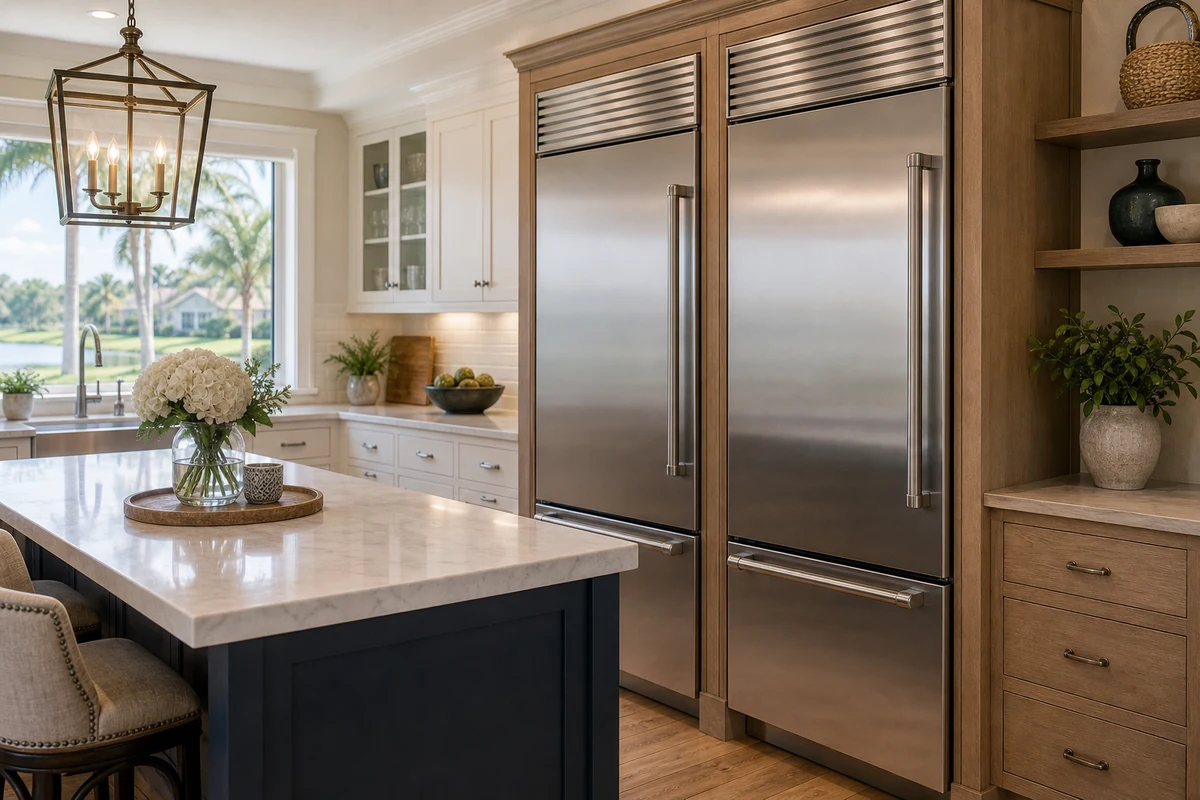
The BI models we see most in 32081
Suffixes matter — they change the doors, the ice system, and sometimes the board revision. Here is the lineup behind most Nocatee kitchens.
| Model | Configuration | What it usually needs |
|---|---|---|
| BI-36U / BI-36UG | 36" over-and-under, freezer drawer below | Control board, evaporator fan, gasket |
| BI-36UFD / BI-36UFDID | 36" french-door over freezer drawer | Mullion seal, ice container, board |
| BI-42S / BI-42SD | 42" side-by-side, dispenser on SD | Dispenser valve, ice maker, board |
| BI-48S / BI-48SD | 48" side-by-side, the largest built-in | Twin evaporator fans, condenser load |
| BI-30U | 30" over-and-under, smaller kitchens | Defrost system, thermistor, gasket |
How a BI unit fails, and what each failure costs
The BI series has a short list of characteristic faults, and knowing the list is most of the diagnosis. The headline one is the brownout lock: after a power outage, the restoration surge scrambles the control board and the panel goes dark while the lights stay on. Northeast Florida averages 100-plus thunderstorm days a year, so from June through October this is the most common BI call we run — and it is a board, not a compressor.
| Symptom | First check on the visit | Usual cost lane |
|---|---|---|
| Lights on, panel blank after an outage | Board power-up and voltage test | $550–$1,100 |
| EC 50 or EC 40 code, long run times | Condenser dust load, then fan draw | $250–$550 |
| Ice maker slow, hollow, or stopped | Scale-restricted water inlet valve | $550–$1,100 |
| Fresh food warm, freezer fine | Evaporator fan motor and airflow | $250–$1,100 |
| Frost on the back wall, food softening | Defrost heater and thermostat continuity | $550–$1,100 |
Two of these — the EC code and the warm-fridge airflow story — often close without a part at all once the condenser coil is cleaned. We never quote board or sealed-system money until the cheap, common causes are ruled out; the EC 50 walkthrough shows how that order works.
Access, evidence, and the repair decision
Built-in means the cabinet, the install, and the gate all factor into a clean repair. Here is how access shapes what we can verify and decide on the spot.
| Access condition | Evidence we can gather | Service decision |
|---|---|---|
| Upper grille clear, unit pulls forward | Full condenser, fan, and board access | Most repairs completed same visit |
| Tight cabinet, panel-fitted surround | Front-access checks; rear needs a pull | Diagnose now, schedule the pull if needed |
| Gated street, attended entry | Nothing changes once we're inside | Gate cleared ahead so the window holds |
| Suspected sealed-system leak | Pressure and frost-pattern evidence | No compressor quote until proof is in hand |
An educational diagnostic scenario from Twenty Mile
A composite case we use for owner education, not a customer review: a 2012 BI-48S in a Twenty Mile kitchen throws EC 50 and runs nonstop. The owner expects a compressor. We pull the unit, find the upper condenser matted with a decade of kitchen film and pollen, clean it, confirm the fan draws normal current, clear the code, and verify pull-down to 38°F. No board, no compressor — a coil cleaning and a cleared display. That order of operations is the difference between a few hundred dollars and a few thousand.
How a BI ages: failure timeline by install year
Because the BI line ran 2008–2022, your install year roughly predicts what's next. Coastal Oaks broke ground in 2006, so its earliest BI units sit at the far end of this curve.
| Install era | Age now | What's coming due |
|---|---|---|
| 2008–2010 (early Coastal Oaks) | 15+ years | Hardened gaskets, scaled ice valves, first board questions; some early-revision boards now rebuilt |
| 2011–2015 (Twenty Mile, Del Webb waves) | 10–14 years | Evaporator fans, thermistors, ice maker modules; storm-locked boards lead the calls |
| 2016–2019 (later villages) | 6–9 years | Mostly maintenance — coil cleaning and filters keep these well clear of repair |
| 2020–2022 (final BI builds) | under 6 years | Check coverage first; late BI installs may still hold sealed-system warranty |
The last row is the honest catch: a BI installed near the line's 2022 end can still carry factory sealed-system coverage, so confirm before paying anyone — the warranty guide shows how to check by serial.
Repair or replace: the BI economics
A built-in is not a $1,200 freestanding fridge you swap on a whim — replacement means the unit plus cabinet rework. Here is the math we walk owners through.
| What's wrong | Repair cost | Our honest call |
|---|---|---|
| Control board, fan, gasket, or ice valve | $250–$1,100 | Repair — a fraction of replacement, parts well supported |
| Compressor on an otherwise sound unit | $1,000–$2,000 | Usually repair — still far under a built-in plus cabinetry |
| Sealed-system / evaporator leak, sound cabinet | $1,500–$3,000 | Often repair on a 15-year unit; we show the evidence first |
| Sealed-system leak plus corrosion or board scarcity | $3,000+ stacked | This is where replacement can win — and we'll say so |
The threshold isn't a slogan, it's arithmetic: when stacked repairs approach the cost of a new built-in plus the cabinet changes a different size forces, replacement earns its place. Until then, a BI built for twenty-plus years is worth keeping — the refrigerator diagnosis visit is where that number gets put on paper.
Reading the BI rating plate and board revision
The BI line ran fourteen years and the control board changed across that span, so the right repair starts with reading two numbers correctly. Get them to us when you book and the right revision rides out, instead of a near-match that won't communicate with the cabinet.
- Find the rating plate. Open the left fresh-food door and look on the upper side wall or the cabinet ceiling. It lists the model — BI-36U, BI-42SD, and so on — plus a serial number.
- Note the width and suffix. The number is the width (36, 42, 48), and the suffix changes the doors and ice system: U is over-under, S is side-by-side, D adds a dispenser, FD is french door, ID is integrated.
- Match the board revision to the serial. Early 2008–2009 boards differ from later ones; a board that ran a 2009 BI-42S won't necessarily talk to a 2016 cabinet. We read the revision off the existing board against the serial before ordering.
- Confirm coverage on late builds. A BI installed near the line's 2022 end can still carry factory sealed-system coverage, so the serial decides who pays before any quote is written.
| Suffix | What it means | The tell it adds |
|---|---|---|
| U (over-under) | Fridge over a freezer drawer | Drawer gasket and a single shared board |
| S / SD (side-by-side) | Two full-height doors; SD adds a dispenser | Dispenser valve and through-door ice path wear |
| FD (french door) | Two fresh-food doors over a drawer | A center mullion seal humidity works on hard |
| ID (integrated) | Panel-ready flush variant | Hinge and panel work joins almost every repair |
An integrated ID variant behaves like a Classic Built-In inside but installs flush like a column, so its visits borrow from the Designer panel and hinge playbook. Read the suffix and you've already narrowed the visit.
BI questions from Nocatee owners
How do I tell which BI model is in my Nocatee kitchen?
Open the left fresh-food door and look on the upper side wall or the top of the cabinet for a rating plate — it lists a BI- number like BI-36U or BI-42SD and a serial. Width is the quick tell: 36, 42, or 48 inches. Read it to us when you book and the right board, gasket, or valve rides out on the truck.
Why does my BI panel go blank but the lights still work after a storm?
That is the BI generation's signature failure: a brownout lock. When power is restored after an outage, a voltage spike can scramble the control board's logic. Interior lights run off a different circuit and keep working, so the unit looks half-alive while cooling has actually stopped. A board swap usually clears it in one afternoon.
Are control boards still available for older BI units, or are they obsolete?
Most BI-series boards are still supplied new; a handful of the earliest 2008–2009 revisions now come rebuilt rather than new. Either way, we identify your exact board revision before quoting, because the wrong revision will not communicate with the unit. We tell you up front whether yours is a stock part or a rebuild.
Do BI-36UFD french-door models break differently than the side-by-sides?
Mostly the same systems, with two wrinkles. The french-door fresh-food section adds a second door gasket and a center mullion seal that humidity here works on hard. And the freezer drawer's ice container and auger see more wear than a fixed bin. We check both extras on any UFD visit as a matter of routine.
My BI is from the first Coastal Oaks homes — is it worth keeping?
Usually yes. A 2006–2010 BI built for a twenty-year-plus life, with a board or ice maker in the hundreds, beats a five-figure built-in replacement plus the cabinet rework a new size demands. When corrosion or a sealed-system leak pushes the repair past replacement logic, we say so plainly — that is the whole point of being independent.
Does a BI control board from one model fit another, or are revisions specific?
Revisions are specific. The BI line ran from 2008 to 2022 and the board changed across that span, so a board pulled from a BI-42S won't necessarily run a BI-36UFD, and an early board won't talk to a later cabinet. We read the revision off your existing board and the rating plate before ordering — fitting the wrong revision is the classic way a DIY board swap fails to communicate.
Why does my older BI ice maker quit while the rest of the unit is fine?
On the BI generation the ice maker has its own water inlet valve and module, and on 14–28 grain Nocatee water the valve scales shut long before the refrigeration ages out. So a perfectly healthy 2010 BI can lose its ice maker purely to mineral restriction — a valve or descale in the $250–$1,100 range, with the rest of the unit untouched.
Does the BI-48S really need two of everything compared with a BI-36U?
Close to it. The 48-inch side-by-side carries twin evaporator fans and a larger condenser load than a 36-inch over-under, so a warm-side complaint on a BI-48S means we check which evaporator and which fan before quoting, and its coil mats faster simply because it rejects more heat. The parts are the same families, just doubled — which is why a BI-48S coil cleaning runs a longer window than a BI-30U's.
Can the condenser fan triac on a BI board fail even with a spotless coil?
It can, and it's the BI trap that fools owners. On BI-generation boards the triac that drives the condenser fan lives on the control board itself. When it fails the fan slows or stops, the unit overheats and may throw EC 50, yet the coil is clean — so a cleaning doesn't fix it. That's a board-level repair in the $550–$1,100 lane, and we confirm it by checking fan current draw before naming the part.
Ready when your Sub-Zero isn't
Weekdays 8 to 7, Saturdays 9 to 3. Gate access handled, floors protected.