Repair · Nocatee & the Ponte Vedra side
Sub-Zero Freezer Repair in Nocatee & Ponte Vedra
Freezers fail in slow motion. Frost, floor ice, and softening ice cream are all early chapters — and all cheaper than the last one.
Sub-Zero Service Nocatee repairs freezer-side faults — frost buildup, defrost failures, clogged drains, and temperature loss — throughout Nocatee 32081 and the Ponte Vedra side of the master plan. Defrost and gasket work typically runs $550–$1,100; drain clearing sits lower, compressor-side faults higher, and the quote is written before parts.
For independent Sub-Zero repair across Nocatee and the 32081 master plan, call (904) 902-0927 for a same-week written quote or Book online.
The three freezer complaints we hear most
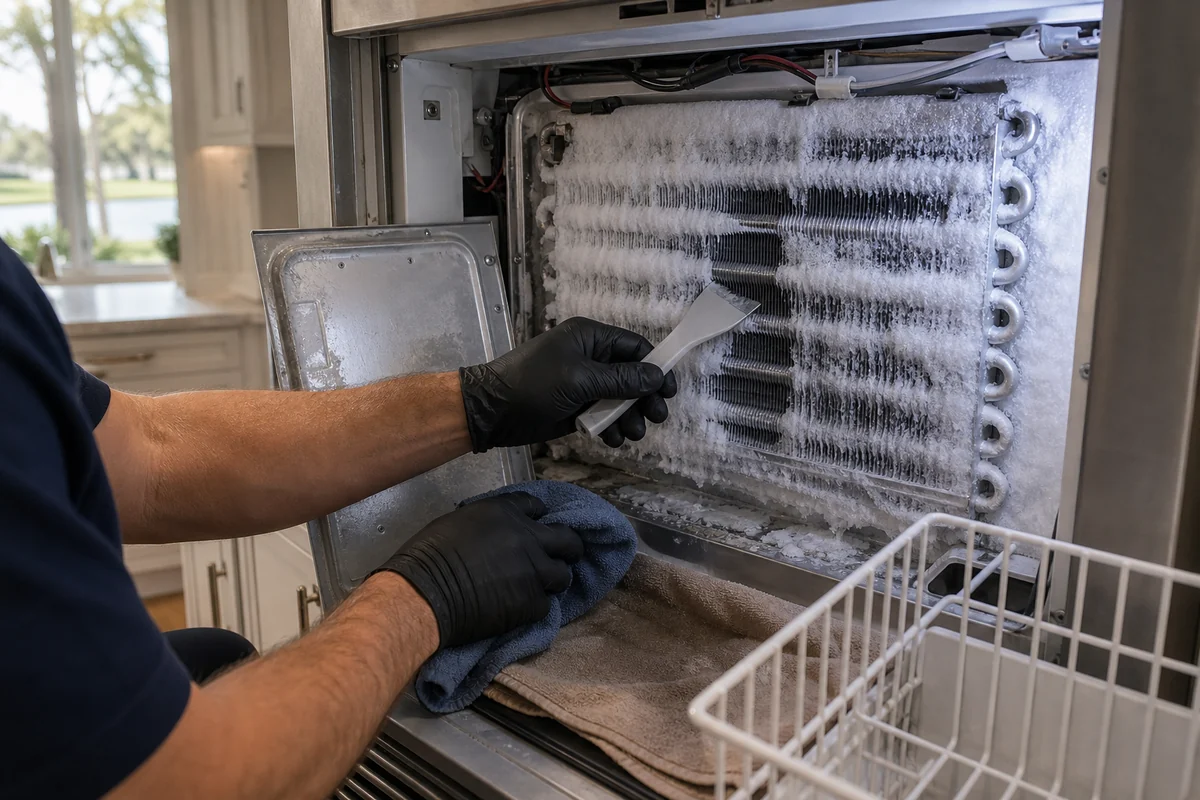
Nearly every freezer call from this ZIP is one of three stories. Frost on the back wall — a defrost heater or defrost thermostat that quit, or a gasket letting humid air in to freeze where it lands. An ice slab on the floor — a defrost drain clogged after thousands of melt cycles. A freezer that won't hold zero — fan, control, or, rarely, the sealed system itself.
A definition worth knowing: the defrost system is a small heater and thermostat that periodically melt frost off the evaporator coil so it can keep absorbing heat. When it fails, the coil ices over, airflow chokes, and the freezer warms even though the compressor runs constantly — our frost and defrost guide walks through exactly which component fails, and it's also a classic trigger for the codes covered in our EC 50 error guide.
Freezer trouble in Nocatee 32081 is a phone call away from a plan: dial (904) 902-0927 or use the online scheduling page, and tell us which of the three stories yours is telling.
What you see, what we test, what it costs
| What you see | What we test first | Typical range |
|---|---|---|
| Frost sheet creeping up the back wall | Defrost heater continuity, then thermostat | $550–$1,100 |
| Ice slab under the bottom basket | Defrost drain flow | $250–$550 |
| Frost ringing the door opening | Gasket seal with a light test | $550–$1,100 |
| Soft ice cream, temps drifting above 0°F | Thermistor and evaporator fan readings | $250–$1,100 |
| Freezer dead, fridge side normal | Which sealed system serves which side | $550–$2,000 |
Humidity is the quiet culprit in this ZIP
Coastal St. Johns County humidity doesn't take winters off, and freezer gaskets pay for it. Every door swing pulls in damp air; the magnetic seal flexes, ages, and eventually admits a steady whisper of moisture that becomes frost. Homes near the preserve edges of Twenty Mile and The Outlook — more shade, more damp — show gasket wear a season or two earlier than the spec sheet suggests. The fix is unglamorous and effective, and it's the same inspection we run on every annual maintenance visit.
Garage and summer-kitchen freezers work hardest of all: ambient heat stretches compressor run time, and pollen plus dust loads the condenser. If yours lives outside conditioned space, put it on a six-month coil cleaning cycle and it will repay you in years.
When it's not the freezer's fault
After an outage — and Nocatee gets its share in storm season — a freezer that seems dead may simply be a control board locked by the restoration surge. Check whether the panel responds before assuming the compressor died; the refrigerator repair page covers the board story in full, and the same boards run both compartments.
What a freezer tech does on arrival
A frosted freezer can hide three different faults, so the visit follows a fixed order that separates a cheap drain job from a defrost repair from a sealed-system call.
- Read the frost pattern. A sheet on the back wall points at the defrost system or a leaking gasket; a slab on the floor points at the drain; a thin even film points at the seal. The location is the first clue.
- Test the defrost circuit. We check the defrost heater for continuity and the defrost thermostat for the right open-and-close behavior. A dead heater is the single most common cause of an iced evaporator here.
- Verify drain flow and the gasket. We pour-test the defrost drain and run a light test on the door seal — in this humidity, a tired gasket admits enough moist air to frost the coldest surface it finds.
- Confirm hold at 0°F. Part fitted or drain cleared, we let the compartment pull back down and verify it holds 0°F against spec before we close up.
If the test points past the defrost system to the sealed side, we stop and gather pressure evidence before quoting — the same evidence-first rule the not-cooling page walks through for the fresh-food side.
The freezer parts we replace most in 32081
Defrost components and gaskets dominate the freezer-side list. Here is what each part fixes and what wears it out in this climate.
| Part | What it fixes | Why it fails here | Lane |
|---|---|---|---|
| Defrost heater | Frost sheet on the back wall, airflow choked | Element burns open after years of cycling; coil ices over | $550–$1,100 |
| Defrost thermostat | Intermittent icing, partial defrost | Contacts drift out of their open-close range | $550–$1,100 |
| Door gasket | Frost ringing the door, long run times | Year-round humidity hardens the seal early | $550–$1,100 |
| Drain clearing / treatment | Ice slab on the freezer floor | Scale and refrozen meltwater plug the drain tube | $250–$550 |
| Evaporator fan motor | Temps drift above 0°F, soft ice cream | Bearing wear stops air moving over the coil | $250–$550 |
Reading the frost: where it sits tells you what failed
Before any tool comes out, the location of the frost narrows the diagnosis. A Sub-Zero freezer ices in distinct patterns, and each one points at a different system and a different cost lane.
| Where the frost sits | What it usually means | Lane |
|---|---|---|
| Thick even sheet across the back evaporator panel | Defrost heater or thermostat failed; coil iced over | $550–$1,100 |
| Band or corner near the door opening | Humid air past a tired gasket or a low-riding door | $550–$1,100 |
| Slab on the floor under the bottom basket | Defrost drain clogged with scale or refrozen melt | $250–$550 |
| Light, fuzzy film over everything, temps drifting | Evaporator fan slowing; air not moving over the coil | $250–$550 |
| No frost, but the whole compartment is warming | Sealed-system or control fault, not a defrost issue | $550–$2,000 |
An educational diagnostic scenario from Twenty Mile
A composite case we use for owner education, not a customer review: a 2013 BI-36U freezer drawer in a Twenty Mile kitchen builds an even sheet across the back panel and the ice cream softens. The owner expects a sealed-system bill. The defrost heater tests open — no continuity — so the coil never sheds frost between cycles and slowly chokes its own airflow. New heater, a drain flush while the panel is off, and the compartment holds 0°F again. A mid-lane repair, not the sealed system the frost made it look like. The evidence-first method is what keeps that distinction from costing thousands.
Freezer questions, answered straight
What causes a sheet of frost on the back wall of a Sub-Zero freezer?
Either the defrost system stopped doing its job — a failed heater or a drifted defrost thermostat — or humid air is sneaking past a tired gasket and freezing on the coldest surface it finds. In Nocatee's year-round humidity, gaskets fail this way more often than the spec sheet expects. Both are mid-range repairs, not unit killers.
Why is there ice under the basket, on the freezer floor?
A clogged defrost drain. Every defrost cycle sends meltwater down a small drain tube; when scale, crumbs, or refrozen water block it, the water pools and freezes into a slab on the floor. We thaw and clear the drain and treat it to slow the next clog — a straightforward visit on its own.
Is it normal for a Sub-Zero freezer to swing a few degrees?
Small movement around the 0°F set point during defrost cycles is normal. Swings you can taste — soft ice cream, frost on packaging, refrozen drips — are not. Those usually mean a thermistor reading wrong, a fan slowing, or door-seal leakage, and they're worth a call before the swing becomes a failure.
My freezer quit but the refrigerator side is fine — how is that possible?
On units with dual refrigeration — the PRO line and the newest generation — each side runs its own sealed system, so one side can fail completely while the other hums along. On single-system units, a freezer-only failure points instead at the evaporator fan, defrost system, or a control fault. Either way it narrows the diagnosis nicely.
Should I manually defrost a Sub-Zero freezer that has iced over?
You can, and it buys time — empty the compartment, leave the door open with towels down, and let it thaw fully. But a frost sheet that returns within days means the defrost system itself failed; manual defrosting only treats the symptom. If you've thawed it once already and the ice came back, that's the signal to book the repair rather than repeat the thaw.
Why does the freezer floor refreeze a few weeks after I chip the ice out?
Because the cause is upstream of the ice you removed. A defrost drain clogged by scale or refrozen meltwater keeps sending every cycle's water back onto the floor, so chipping it clears the slab but not the blockage. We thaw and flush the drain line and treat it to slow the next clog — that's the difference between clearing ice and fixing the drain.
How do I tell a failed defrost heater from a leaking gasket when both cause back-wall frost?
The pattern and the timing differ. A failed defrost heater builds a thick, even sheet across the whole evaporator panel over a week or two, and the freezer warms as airflow chokes. A leaking gasket frosts in a band near the door opening or one corner — wherever humid air sneaks in — and the rest of the panel stays clear. We test the heater for continuity and run a light test on the seal to settle it on the visit.
My garage Sub-Zero freezer struggles only in summer — is that normal or a fault?
It's the environment, not necessarily a fault. A freezer in an unconditioned Nocatee garage or summer kitchen fights ambient heat that can top 95 degrees, so the compressor runs far longer to hold 0°F and any marginal coil load shows up fast. We check the gasket and coil first, and put garage units on a six-month coil-cleaning cycle — that combination keeps most of them holding temperature through August.
Ready when your Sub-Zero isn't
Weekdays 8 to 7, Saturdays 9 to 3. Gate access handled, floors protected.